By Nathalie · Published: April 2026 · Last updated: April 2026
Taxon: Maxillaria rodrigueziana J.T.Atwood & Mora-Ret. (1989)
Family: Orchidaceae
Subtribe: Maxillariinae
An orchid that earns its space
I bought this plant from Ecuagenera last year. It grows in a hanging pot — a mix of sphagnum moss and small bark — and this is already its second blooming with me. That says something about the plant: it is generous, it adapts, and it rewards attentive growing.
The second bloom was something of a surprise. But on regular basis, I remove the orchid from the orchidarium for cleaning and it often trigger some orchids to bloom a few days after.
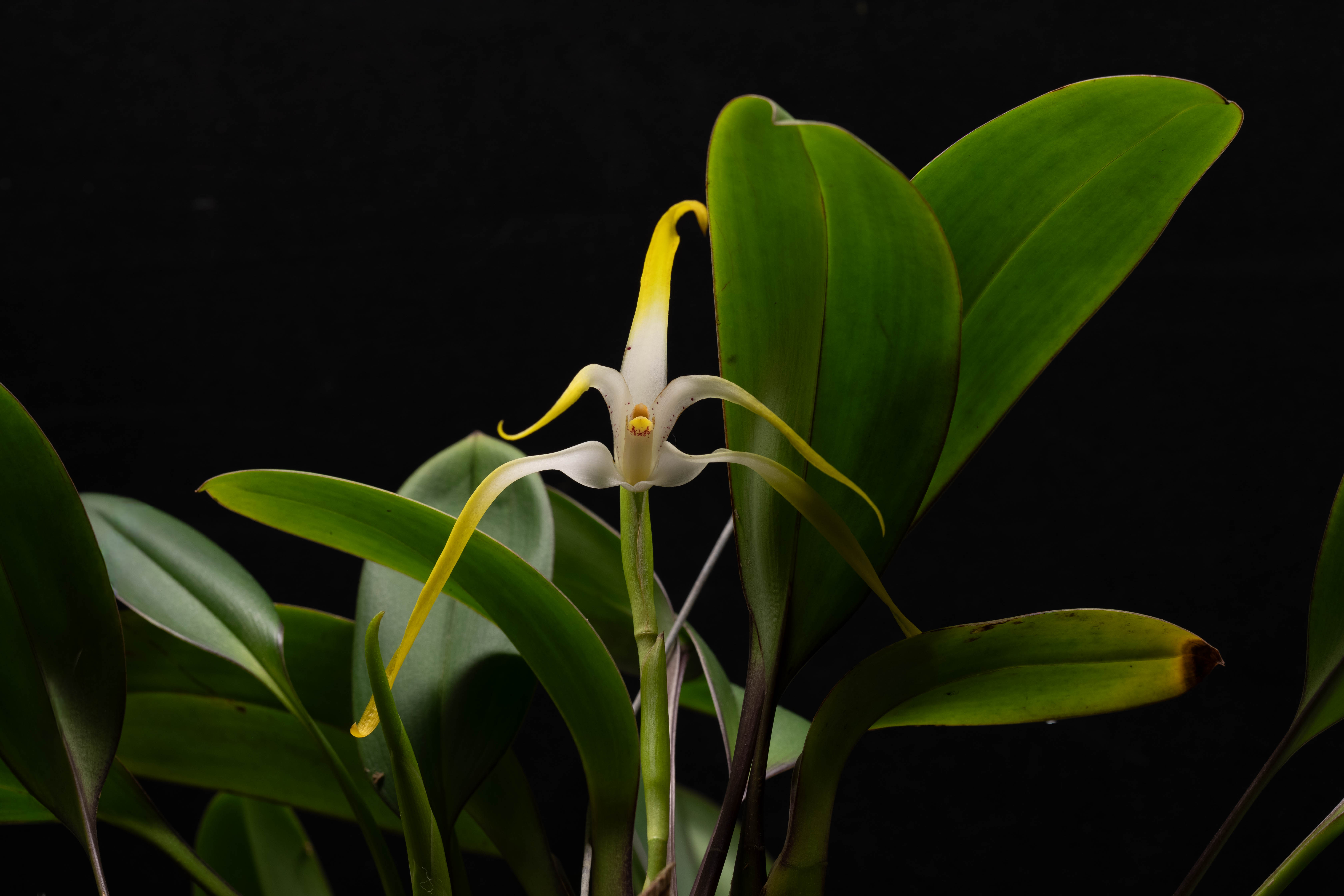
The first challenge it posed was photographic. The inflorescences emerge from the base of the plant and the flowers hang downward, faces tilted toward the floor. To see what the bloom actually looks like from the front, you have to get inventive — tilt the pot, crouch low, use a small mirror underneath, or simply accept that your photographs will involve some gymnastics. It is worth every awkward angle.
I focus on miniature orchids, so Maxillaria rodrigueziana is, strictly speaking, a misfit in my orchidarium. It takes up considerably more space than everything else. But it blooms with an elegance that is hard to argue with — and some plants simply earn the room they take.

Species overview
Maxillaria rodrigueziana is a medium-sized epiphytic orchid in the genus Maxillaria, subtribe Maxillariinae, family Orchidaceae. It was formally described in 1989 by botanists J.T. Atwood and Mora-Retana in Icones Plantarum Tropicarum — making it a relatively recent addition to the botanical record. The species is native to Costa Rica and Panama, where it grows as an epiphyte on tree trunks in wet tropical cloud forests at elevations around 600 metres (approximately 2,000 feet).
Its distinguishing features are its showy single flowers — up to 12 cm across — white to yellow with a vivid orange lip, and a basal inflorescence that faces downward when in full bloom. The species is described in the literature as fragrant, though as with many orchids, scent can vary by individual plant, time of day, and growing conditions. It flowers in spring to summer and is widely considered one of the more rewarding Maxillaria species in cultivation.
Plant structure
The plant produces ovoid, rugose pseudobulbs wrapped at their base by inflated sheaths. Each fan-shaped growth carries two to three long-petioled, spatulate leaves that can reach up to 35 cm (14 inches) in length, giving the plant a bold, arching silhouette. It is distinctly larger than miniature Maxillaria species, and growers should plan for a pot or basket of some size.


Flowers
Each inflorescence produces a single flower that can measure up to 12 cm (5 inches) across. The lateral sepals sweep elegantly outward; the dorsal sepal leans forward; and the lateral petals frame the column in a posture that is both structured and graceful. Colouration moves from white — sometimes marked with red blotches — to bright yellow toward the tepal tips. The lip is a vivid orange; the anther cap echoes that warmth.
The fragrance is strong and distinctive: sweet and heady, with the intensity of a tropical perfume. Blooming occurs in spring to summer on basal inflorescences arising from mature growths. A single plant in good health can produce multiple spikes simultaneously, each encased in four to seven inrolled bracts before opening.
From my orchidarium
The elegance of the flower is its defining quality — once you manage to see it face-on, despite the downward-hanging habit, it is genuinely striking. The orange lip against the white and yellow petals creates a warmth you don’t easily forget. On fragrance: I went to check mine and couldn’t detect a scent. It’s possible it’s not the right time of day — many orchid fragrances are strongest in the morning and fade by afternoon. Worth investigating at different hours.
Native habitat
In the wild, Maxillaria rodrigueziana grows epiphytically on tree trunks in the cloud forests of Costa Rica and Panama. These habitats are characterised by consistently high humidity, dappled light filtered through a dense canopy, warm temperatures year-round, and a marked dry season from December through March. Understanding this seasonal rhythm is key to cultivating the plant successfully.
Care guide
Maxillaria rodrigueziana is widely regarded as an approachable species for intermediate growers. Its requirements mirror its cloud-forest origins: good humidity, filtered light, and a clear seasonal rhythm with a distinct dry rest in winter.
| Care at a Glance | |
| Light | Shade to bright indirect — 1,500 to 2,500 footcandles |
| Temperature | Intermediate: 13–29 °C (55–85 °F) |
| Humidity | High; typical of tropical cloud-forest conditions |
| Watering | Frequent during growth (4–7× per week); reduce to every 2–3 weeks during rest |
| Fertilisation | Balanced fertiliser during active growth; stop completely during the dry rest period |
| Rest period | December – March. Reduce water, no fertiliser; allow pseudobulbs to shrivel slightly |
| Blooming | Spring to summer, on basal inflorescences from previous growth |
| Fragrance | Described in literature as strong and sweet; may vary by plant and time of day |
Light
This species thrives in shade to bright indirect light — ideally between 1,500 and 2,500 footcandles. Direct midday sun will scorch the leaves. An east-facing window, a shaded greenhouse bench, or a well-lit orchidarium with filtered LED lighting all work well.
Temperature
Intermediate conditions suit it best: a minimum of 13 °C (55 °F) at night and a maximum of around 29 °C (85 °F) during the day. During the winter rest, night temperatures of 12–13 °C (54–55 °F) help trigger reliable blooming the following season.
Watering & the rest period
During the active growing season (roughly April through November), water frequently — up to four to seven times per week, depending on your conditions and potting medium. The roots should never fully dry out during this period.
From December through March, reduce watering significantly to every two to three weeks. Allowing the pseudobulbs to shrivel slightly during this dry rest is acceptable and natural. Stop fertilising completely during the rest period — growers who continue feeding through winter often find that flowering is compromised the following spring.
From my orchidarium
Full disclosure: I did not follow the textbook rest period. I maintained lower fertilisation through winter and let the medium dry between waterings.
Fertilisation
Use a balanced fertiliser (20-20-20 or similar) at half strength during the growing season, applied with each watering or weekly. Taper off in November and stop entirely through the dry rest. Resume gradually once new growth appears in mid-March.
Potting & medium
Maxillaria rodrigueziana does well mounted on cork or tree-fern slabs with a little moisture-retaining material at the roots, or grown in baskets or pots with a coarse, free-draining epiphyte mix. Given its size, a basket allows the basal inflorescences to hang freely — which also makes photographing the downward-facing flowers somewhat easier.
From my orchidarium
Mine grows in a hanging pot with a mix of sphagnum moss and small bark. The hanging position has a practical bonus: the basal inflorescences can dangle freely, which makes it a little easier to photograph the downward-facing blooms from below. If you collect miniatures, be honest with yourself about the space you’re willing to dedicate — this plant commands attention, and real estate.
Frequently Asked Questions
Is Maxillaria rodrigueziana easy to grow?
Yes — it is widely considered one of the more accessible Maxillaria species for intermediate growers. It tolerates a range of light and temperature conditions, grows vigorously, and blooms reliably when given a proper winter rest. Beginners with some epiphyte experience should find it manageable.
When does Maxillaria rodrigueziana bloom?
Flowering typically occurs in spring to summer, on basal inflorescences arising from mature pseudobulbs. Each inflorescence carries a single large flower. In cultivation, triggering blooming depends on observing a dry rest period from December through March.
Does Maxillaria rodrigueziana need a rest period?
Yes, and this is considered one of the most important care requirements. From December through March, reduce watering to every two to three weeks and stop fertilising completely. A slight shrivelling of the pseudobulbs during this period is normal. Skipping the rest period — especially continuing to fertilise through winter — is the most common reason this species fails to bloom.
How big does Maxillaria rodrigueziana get?
It is a medium-sized orchid. The leaves can reach up to 35 cm (about 14 inches) in length, and the flowers are up to 12 cm (5 inches) across — notably large for a single-flowered Maxillaria. It is not a plant for small orchidarium spaces.
Why do the flowers face downward?
The inflorescences emerge from the base of the plant and the flowers naturally hang downward. This is a characteristic of the species. To photograph or appreciate the bloom face-on, you need to tilt the pot or look up from below. Growing in a hanging basket makes this easier.
Is Maxillaria rodrigueziana fragrant?
The species is described in botanical literature and grower reports as producing a strong, sweet fragrance. However, orchid scent is notoriously variable — it can depend on the individual plant, the time of day (many species are most fragrant in the morning and scentless by afternoon), temperature, and growing conditions. My own plant has not produced a detectable scent so far, which may simply be a matter of timing. If you want to assess fragrance, check in the morning within an hour or two of your grow-light turning on.
Where can I buy Maxillaria rodrigueziana?
Ecuagenera, the renowned Ecuadorian orchid nursery, has been a reliable source for this species. Specialist orchid nurseries in Europe and North America occasionally stock it, and it appears at orchid society auctions and sales. Andy’s orchid is another vendor offering this orchid. It is not a common supermarket orchid and may require some hunting.
References & further reading
- Atwood, J.T. & Mora-Retana, D. (1989). Maxillaria rodrigueziana. Icones Plantarum Tropicarum 14: t. 1361.
- Plants of the World Online — Maxillaria rodrigueziana J.T.Atwood & Mora-Ret.
- GBIF — Maxillaria rodrigueziana occurrence data
- Orchid Species Encyclopedia — Maxillaria rodrigueziana
- American Orchid Society — Maxillaria culture information
- Ecuagenera — Central American orchid nursery and species source