By Nathalie · Published: April 2026 · Last updated: July 2026
Family: Orchidaceae | Subfamily: Epidendroideae | Tribe: Epidendreae | Genus: Epidendrum | Species: E. summerhayesii Hágsater & E.Santiago
Some orchids you seek out deliberately. Epidendrum summerhayesii was not one of those for me — it was an accidental purchase. I did not know exactly what I was getting when I bought it, and I will admit the plant is not small. But since it settled in, I have not been able to complain: it blooms almost without pause, its thick, fleshy flowers opening successively and changing colour from green to purple as they mature. I currently grow it in a north-facing bedroom under artificial light, and it has responded well enough that I am planning to move it outside for the summer. That kind of resilience tends to win you over quickly.
Species Overview
Epidendrum summerhayesii Hágsater & E.Santiago is a cool-growing, reed-stemmed epiphyte native to the cloud forests of Costa Rica, Panama, Colombia, and Peru, growing at elevations of 1,200–1,800 metres. Named in honour of the British orchidologist Victor Samuel Summerhayes, it belongs to the Spathiger group within the genus — a cluster of reed-stem Epidendrum species characterised by laterally compressed, cane-like stems, fleshy flowers, and notably unusual nocturnal scent. In cultivation it is valued above all for the near-continuousness of its blooming: a well-grown plant can carry flowers in almost every season, opening them successively along a branched inflorescence.
Plant Structure
Epidendrum summerhayesii produces upright, cane-like stems that are distinctly laterally compressed (flattened rather than round in cross-section), a structural trait shared across the Spathiger group. The stems branch and carry alternating, leathery leaves along their length. The plant does not produce pseudobulbs; like all reed-stem Epidendrum, it stores moisture in its fleshy canes rather than in swollen pseudobulbs. The overall growth is robust; this is not a miniature. It spreads by branching canes and can become a sizeable specimen with time, particularly when given the consistent conditions it prefers.
Flowers
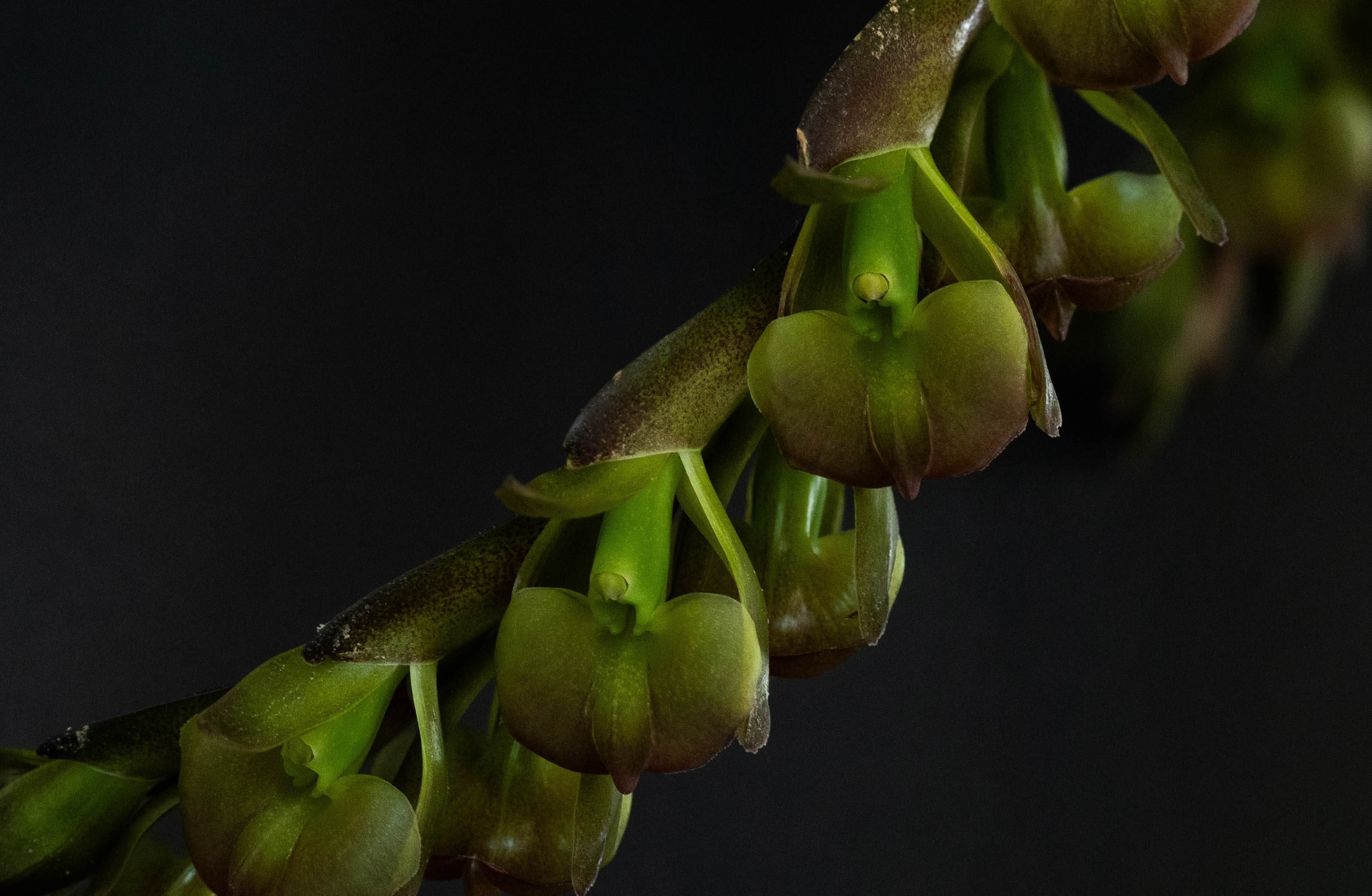
The flowers of E. summerhayesii are fleshy and about 2.5 cm (1 inch) across, carried in short, branched clusters at the tips of the canes. One of their most distinctive traits is a colour shift with age: they open in shades of green and progressively deepen to purple or violet as they mature, so a flowering stem can simultaneously display a range of hues. The lip is lobed and often contrasting in colour with the rest of the flower. Flowers open successively rather than all at once, which is what gives the plant its reputation for near-continuous bloom


From my orchidarium
This one came to me by accident, but it has turned out to be one of the most reliably blooming plants in my collection. The flowers are thick and substantial — I would describe them as sturdy rather than delicate — and the colour shift from green to purple as they age is genuinely striking. I grow it under artificial light in a north-facing bedroom and it has not stopped flowering since it settled in.
Pollinators
The pollination biology of Epidendrum summerhayesii has not been studied in detail, but its biology offers strong clues. Reed-stem Epidendrum in the Spathiger group are predominantly pollinated by butterflies and moths — the nocturnal scent of E. summerhayesii in particular points toward hawkmoth (Sphingidae) pollination, a common syndrome in high-elevation neotropical orchids. Hawkmoths are active at night and are strongly attracted to flowers with a musky or faintly musty nocturnal fragrance, exactly the character recorded for this species. Many members of the Spathiger group practice deceptive pollination — producing scent without offering a nectar reward, exploiting the moths’ foraging behaviour without any return payment. This strategy is evolutionarily effective but requires a local population of the correct pollinator; it likely contributes to the species’ reliance on specialist insects in the wild.
Native Habitat
Epidendrum summerhayesii is native to the montane cloud forests of Costa Rica, Panama, Colombia, and Peru, growing at elevations between 1,200 and 1,800 metres above sea level. At these altitudes, the climate is characterised by cool, relatively stable temperatures, high humidity, frequent cloud cover, and a diffuse, filtered light regime. Day temperatures typically fall between 18 and 22°C, and nights are noticeably cool. The plants grow as epiphytes — anchored to branches and tree trunks — in forest environments where air movement is good and roots are never waterlogged.
These cool, humid forest conditions are important context for cultivation. The species’ upright, cane-forming habit and its fleshy, weather-resistant flowers are adaptations to a climate that is reliably cool and moist but where the plants experience both bright periods and extended cloud cover. The near-continuous bloom cycle in cultivation probably reflects the absence of a strongly seasonal dry or cold trigger that would otherwise concentrate flowering in the wild.
Care Guide
Epidendrum summerhayesii is a resilient, rewarding orchid that tolerates a wider range of conditions than many cool-growing cloud forest species. Its one firm preference is for cool temperatures; give it that, and it will reward you
Care at a Glance
| Parameter | Recommendation |
| Orchidarium | Cold orchidarium; currently thrives in a cool, bright bedroom |
| Temperature | Cool; days 18–22°C (64–72°F); nights 10–14°C (50–57°F) |
| Light | Moderate; 10,000–15,000 lux; tolerates north-facing bright indirect light |
| Humidity | 70–80% |
| Watering | Once per week; keep evenly moist; allow brief drying between waterings |
| Fertiliser | Weekly, diluted in watering water |
| Potting mix | Loose, fast-draining; fir bark or coconut husk; pot or basket |
| Bloom season | Year-round / near-continuous in cultivation |
Which Orchidarium?
With a native range spanning 1,200–1,800 m cloud forests, E. summerhayesii is a natural fit for the cold orchidarium, where temperatures can be kept below 21°C / 70°F — closely mimicking the cool montane conditions it evolved in. In the meantime, a cool, north-facing bedroom under LED grow lights is a sensible intermediate; the plant has demonstrated it can bloom successfully in these conditions. Moving it outdoors in summer (to a shaded, sheltered spot) provides the cool nights it enjoys and is a straightforward way to give it a seasonal refresh.

Light
Despite its cloud forest origins, E. summerhayesii is not a deep-shade plant. In the wild it grows in the upper canopy where light is filtered but still substantial. In cultivation, 10,000–15,000 lux is a reasonable target. North-facing bright indirect light, supplemented with LED grow lights, provides adequate light for both vegetative growth and flowering. If the canes become etiolated or flowering slows, increasing light intensity is the first adjustment to make.
Watering & Fertilising
As a cane orchid without pseudobulbs, E. summerhayesii has limited water storage capacity, so it should not be allowed to dry out completely for extended periods. At the same time, the roots need air — a loose, fast-draining medium is important. Weekly watering with fertiliser added to the water suits this species well. In summer, particularly if moved outdoors, it may benefit from more frequent watering in warm weather. In cool months the interval can extend slightly, but the medium should never remain bone dry for long.
Frequently Asked Questions
Is Epidendrum summerhayesii a miniature orchid?
Not really. While the flowers are modest in size — about 2.5 cm across — the plant itself grows as a multi-caned specimen that can become quite large with time. It is best described as a medium-sized reed-stem orchid rather than a miniature.
Why does Epidendrum summerhayesii change colour?
The colour shift from green to purple as the flowers age is a natural ageing process common in this group of Epidendrum. It is not a sign of stress — it is simply what the flowers do. The variation in colour across a single inflorescence (younger flowers green, older ones purple) is one of the species’ most attractive features.
How do I get Epidendrum summerhayesii to bloom?
This species blooms almost continuously under good conditions. The key requirements are cool temperatures and adequate light. If flowering slows, the most likely causes are insufficient light or temperatures that are too warm. A summer outdoors in a sheltered spot can help by providing the cool nights the plant enjoys.
Does Epidendrum summerhayesii smell?
Yes, but the fragrance is nocturnal and described as weakly foul or musty — part of a deceptive pollination strategy that attracts hawkmoths without offering them a nectar reward. The scent is generally not noticeable indoors during the day.
Can Epidendrum summerhayesii be grown under artificial light?
Yes. It adapts well to LED grow lights, provided the light intensity is adequate (10,000–15,000 lux) and temperatures remain cool. Many growers successfully bloom this species under artificial light in cool rooms or basement setups.
Which orchidarium is best for Epidendrum summerhayesii?
E. summerhayesii is a cool-growing species from 1,200–1,800 m cloud forests and belongs in a cold orchidarium (target below 21°C / 70°F). It will also grow in a cool bedroom or other cool indoor space under adequate light.
Does Epidendrum summerhayesii need a rest period?
Not in the conventional sense. It blooms near-continuously without requiring a distinct dry or cold dormancy. However, moving it outdoors in summer can provide naturally cool nights that stimulate healthy vegetative growth, and the mild seasonal variation this creates does no harm.
How fast does Epidendrum summerhayesii grow?
It is a reasonably vigorous grower under good conditions. The canes branch freely and the plant can become a substantial specimen over several years. Regular fertilising throughout the year supports steady growth.