By Nathalie Koch | June 2026
Family: Orchidaceae | Subfamily: Epidendroideae | Genus: Maxillaria | Species: M. tenuifolia Lindl.
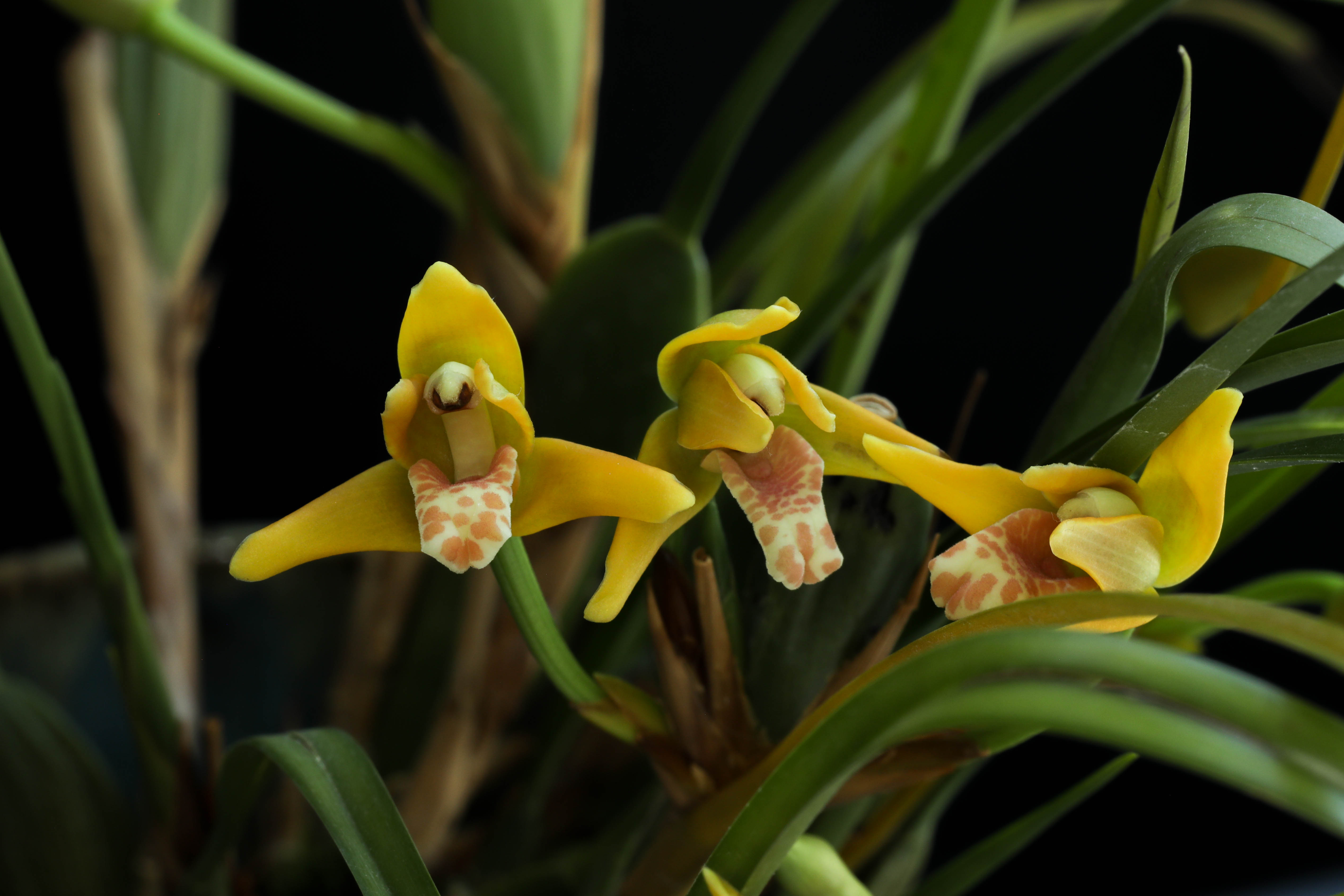
Some orchids earn their place in a collection through sheer drama. Maxillaria tenuifolia earns it through fragrance. Mine is the yellow form, and it blooms faithfully every May — filling the orchidarium with an unmistakable scent of fresh coconut. It is one of those orchids that asks for very little: grow it warm, water it weekly, and it rewards you with reliable spring blooms, year after year. One of the most genuinely easy orchids I grow, and one of the most rewarding.
Species Overview
Maxillaria tenuifolia Lindl., commonly known as the Coconut Orchid or Coconut Pie Orchid, is a warm- to intermediate-growing epiphyte native to southern Mexico and Central America. Described by John Lindley in 1837 from a specimen collected near Veracruz, Mexico, it ranks as one of the most popular species in the Maxillaria alliance. Its grass-like foliage is ornamental even out of bloom, and in flower it perfumes a room with a rich coconut scent that shifts character throughout the day. The American Orchid Society describes it as “one of those orchids that belongs in every collection.” The yellow form — producing clear golden flowers rather than the classic oxblood red — is a sought-after colour variant that retains all the charm and fragrance of the species.
A note on taxonomy: a revised classification published in 2011 by M.A. Blanco and Carnevali transferred this species to the genus Maxillariella, making the current accepted name Maxillariella tenuifolia (Lindl.) M.A.Blanco & Carnevali. Both names circulate widely in the hobby; they refer to exactly the same plant.
Plant Structure
Maxillaria tenuifolia produces clustered pseudobulbs connected by a long, creeping rhizome — the source of its characteristic habit of slowly climbing out of pots over time. Each pseudobulb carries a single narrow, strap-like leaf that can reach 20–30 cm in length. The foliage is bright green, fine-textured, and almost grass-like; it gives the plant an elegant, airy appearance and makes it an attractive houseplant between flowering cycles. The wandering rhizome makes basket culture or mounting on cork slabs a natural fit, allowing the plant to spread freely without becoming confined.


Flowers
Flowers appear at the base of the pseudobulbs in spring, one per spike, measuring approximately 3–4 cm across. The typical form displays deep oxblood-red petals and sepals with yellow or brown speckling toward the centre, and a lip that is yellow marked with red. The yellow form — sometimes listed as var. flavescens — produces flowers ranging from pale gold to bright yellow, occasionally with light spotting or a clean, unmarked lip. Selected clones such as Maxillaria tenuifolia ‘Yamada’ AM/AOS have received American Orchid Society awards for exceptional flower quality.
The fragrance is the defining characteristic of the species. The coconut scent evolves across the day: fresh and rich in the morning, shading toward cocoa butter through midday, and mellowing into a warm popcorn-butter character by late afternoon. Flowers last one to two weeks in good condition, longer if temperatures are kept cool.

Pollinators
In the wild, Maxillaria tenuifolia is pollinated primarily by stingless bees of the tribe Meliponini — particularly species in the genus Trigona, which share the same tropical range as the orchid. These small, highly social bees are drawn by the coconut-scented floral volatiles the flowers release during daylight hours, a timing that aligns with the bees’ active foraging windows in tropical environments. The broad, prominent lip functions as a landing platform, guiding visitors toward the column and ensuring contact with the pollinia.
Unlike orchids that practise deceit pollination — mimicking food or mates while offering no reward — M. tenuifolia is believed to provide genuine floral rewards to its pollinators, possibly oils or nectar, though this has not been fully documented across all populations. What is clear is that the coconut scent functions as a long-distance attractant, and the architecture of the flower ensures that visiting bees depart carrying pollen.
Native Habitat
Maxillaria tenuifolia is distributed from Mexico through Guatemala, Belize, El Salvador, and Nicaragua, with possible occurrence in Costa Rica. It is primarily a lowland to mid-elevation species, recorded at altitudes up to approximately 1,500 m (4,921 ft) above sea level. In the wild it grows as an epiphyte on tree branches and trunks in warm rainforests, semi-deciduous tropical forests, and humid oak-forest ravines, where it receives dappled light filtered through the canopy. Its native climate is characterised by a pronounced wet season and a dry season running roughly from December through April or May — a seasonality that informs its watering requirements in cultivation.
Care Guide
Despite its exotic fragrance and striking flowers, Maxillaria tenuifolia is one of the most forgiving orchids in cultivation. It tolerates a range of conditions, adapts readily to different growing environments, and asks for little beyond good light, adequate airflow, and a medium that drains freely.
Care at a Glance
| Parameter | Recommendation |
| Orchidarium | Hot orchidarium (warm-growing species) |
| Temperature | Warm to intermediate; minimum 10°C (50°F); days 18–24°C (65–75°F) |
| Light | Medium-bright; 1,500–3,500 foot candles; between Cattleya and Phalaenopsis conditions |
| Watering | Weekly during active growth; reduce to every 2–3 weeks November–March |
| Fertiliser | Weekly, diluted in watering water |
| Humidity | 50% or higher |
| Potting mix | Open, fast-draining; fir bark, coconut husk chunks, perlite; baskets or cork slabs ideal |
| Bloom season | Spring — typically April–May |
Which Orchidarium?
As a warm- to intermediate-growing species native to lowland and mid-elevation tropical forest, Maxillaria tenuifolia is well suited to the hot orchidarium. Its natural habitat is warm and humid, and the species is tolerant of temperature fluctuations — making it a natural fit for a non-climate-controlled growing environment. It is one of the more adaptable species in the genus, and experienced growers have flowered it successfully across a wide range of temperatures.
Light
Medium-bright light is ideal — roughly equivalent to Cattleya conditions, or 1,500–3,500 foot candles. The species tolerates a broad range, but insufficient light is the most common reason a plant fails to flower. If the foliage is long, whippy, and dark green but the plant does not bloom, more light is the first remedy. M. tenuifolia performs well under LED grow lights and adapts to both artificial and natural light.
Watering & Fertilising
In its native habitat, M. tenuifolia experiences a distinct dry season from December through April or May. In cultivation, this translates to a moderate reduction in watering over winter — allowing the medium to dry more thoroughly between sessions, or reducing frequency to every two to three weeks from late November through March. During active growth, weekly watering is appropriate. The medium should never be kept consistently wet at any time of year; soggy roots are the main threat to this species.
Fertiliser added weekly to the watering water suits M. tenuifolia well. It is not a heavy feeder but responds well to consistent, light nutrition through the growing season.
Potting and Mounting
The wandering rhizome means M. tenuifolia will eventually climb out of a standard pot. Basket culture is the ideal solution, allowing the rhizome to spread without constraint. Cork slabs and tree fern mounts work equally well and make a handsome display. If grown in a pot, use an open, fast-draining mix of fir bark, coconut husk chunks, and perlite. Sphagnum moss is the least suitable choice — the roots are intolerant of consistently moist conditions. Plan to repot every two to three years, or when the medium begins to break down.
Frequently Asked Questions
What does Maxillaria tenuifolia smell like?
Maxillaria tenuifolia produces a rich, evolving coconut-based fragrance released during daylight hours. In the morning the scent is fresh and strong, most comparable to fresh coconut. Through midday it mellows toward cocoa butter, and by late afternoon it takes on a warmer, popcorn-butter character. The fragrance is one of the most distinctive in the orchid world and is the primary reason the species is so widely grown.
Is Maxillaria tenuifolia easy to grow?
Yes. It is widely regarded as one of the most beginner-friendly species in the Maxillaria alliance. It tolerates a broad range of temperatures and light levels, and is forgiving of minor lapses in care. The main requirements are good drainage, adequate light, and a moderate dry period in winter.
Why isn’t my Maxillaria tenuifolia flowering?
The most common cause is insufficient light. If the foliage is lush and dark green but the plant never blooms, move it to a brighter position. A slight reduction in watering through winter can also help trigger spring blooming by mimicking the natural dry season.
What is the difference between the red form and the yellow form of Maxillaria tenuifolia?
The typical form produces flowers in deep oxblood red with yellow-brown speckling. The yellow form (sometimes listed as var. flavescens) produces flowers in clear gold or pale yellow, sometimes with light spotting. Both forms share the same coconut fragrance and identical care requirements. The yellow form is less common in the trade than the red but is equally easy to grow and flower.
How often should I water Maxillaria tenuifolia?
Weekly watering works well during active growth. From late November through March, reduce to every two to three weeks, allowing the medium to dry out more between waterings. Avoid keeping the medium consistently wet at any time of year.
Can Maxillaria tenuifolia be grown indoors?
Yes. It grows well on a bright windowsill (any orientation except north), in a home orchidarium, or under grow lights. The main requirement indoors is adequate light; provided this is met and the medium drains freely, the plant adapts readily to indoor conditions. As a bonus, the coconut fragrance makes it a very pleasant houseplant during bloom season.
What is Maxillariella tenuifolia — is it the same plant?
Yes. Maxillariella tenuifolia is the current accepted name for the species following a taxonomic revision in 2011, in which the Maxillaria genus was reorganised and many species transferred to new genera. In cultivation the name Maxillaria tenuifolia remains widely used. Both names refer to exactly the same orchid.
When does Maxillaria tenuifolia bloom?
Flowering season is spring — typically April through May in cultivation. Individual flowers last one to two weeks, and well-grown plants bloom reliably every year.