By Nathalie Koch | Published January 2025 | Updated June 2026
Family: Orchidaceae | Subfamily: Epidendroideae | Tribe: Epidendreae | Genus: Epidendrum | Species: E. trialatum Ames & C.Schweinf.
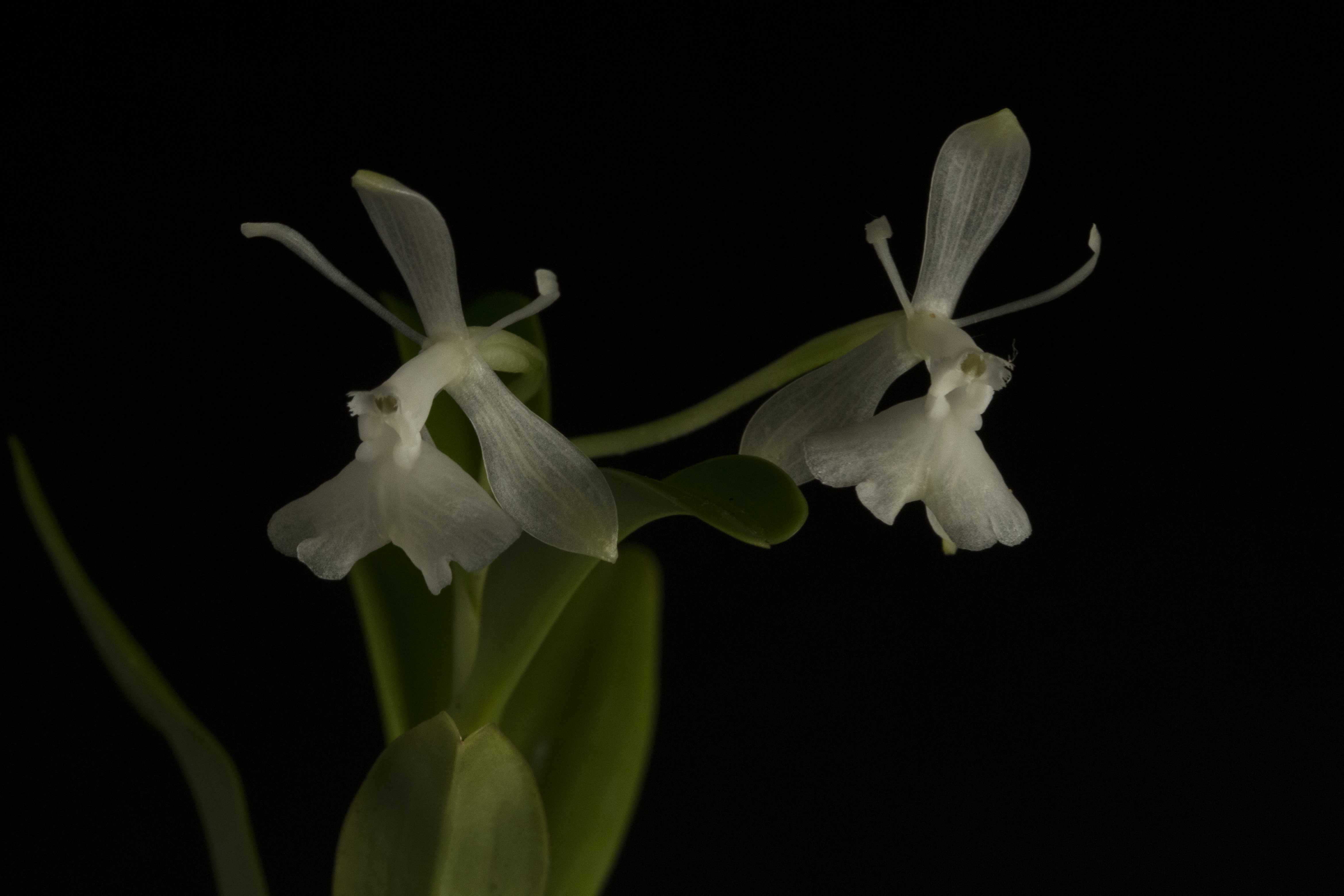
This is the second year Epidendrum trialatum has bloomed for me, which is gratifying — a plant that blooms reliably in consecutive years is a plant that is genuinely settled in its environment. The flowers are small, about 1 cm, and produced in clusters of three to four along the branching stems. They look delicate, almost fragile, in the typical way of small-flowered Epidendrum, but the profusion of them — around fifty flowers when the plant is in full display — creates a cumulative effect that is more substantial than any individual bloom would suggest.
Species Overview
Epidendrum trialatum Ames & C.Schweinf. is a warm- to hot-growing epiphyte native to Nicaragua, Panama, and Costa Rica, growing at low to moderate elevations of 50–1,000 metres. The specific epithet trialatum means three-winged, referring to a structural feature of the flower column. Like other members of the reed-stem Epidendrum alliance, it produces cane-like stems and flowers from branching terminal inflorescences. The flowers are small — approximately 1 cm — but produced in clusters of three to four along the inflorescence branches, giving a blooming plant the appearance of many small flower heads distributed across the stem tips. The bloom season in the natural range runs from fall through spring.
Plant Structure
Epidendrum trialatum produces upright, slender, reed-like canes with alternating, leathery leaves. The canes branch at the tips to produce the inflorescence, with multiple branching points each carrying a small cluster of flowers. The plant does not produce pseudobulbs. Growth is sympodial — new canes emerge from the base of existing ones and the plant spreads to form a multi-stemmed clump over time. The overall growth form is open and branching, giving the plant a somewhat airy appearance that is distinct from the more densely leafed reed-stem species.


Flowers
The flowers of E. trialatum are small — approximately 1 cm across — and produced in tight clusters of three to four at the tips of each inflorescence branch. The branched inflorescence means that a well-established plant can carry as many as fifty or more individual flowers simultaneously. The flowers have the typical Epidendrum structure: three similar sepals, two petals, and a lobed lip. The colouration is typically in shades of green, white, or cream, sometimes with purple or rose tinting on the lip. The individual flowers look delicate, with a fine translucent texture, but this is normal for the species rather than a sign of poor health.
Pollinators
Reed-stem Epidendrum species in Central America are predominantly pollinated by butterflies and moths (Lepidoptera) — a pollination syndrome shared with many of their close relatives. The small, pale flowers of E. trialatum, which are often fragrant (the fragrance is not confirmed for this specific species), fit the general profile of butterfly-pollinated orchids: flowers grouped at a height accessible to hovering insects, with a landing platform formed by the lip and petals, and typically a reward of nectar. Some Epidendrum in the Spathiger alliance are deceptive pollinators (mimicking nectar sources without providing them), while others do provide nectar; the pollination mode of E. trialatum specifically has not been studied in detail.
Native Habitat
Epidendrum trialatum is native to Nicaragua, Panama, and Costa Rica, growing at elevations of 50–1,000 metres in warm, humid lowland and pre-montane forest. Central American lowland and foothill forests in this elevation range experience warm to hot temperatures year-round with no significant cold season. Humidity is high, and the plants grow as epiphytes in the forest canopy and subcanopy where they receive filtered light. The absence of a cold season in the native range is consistent with the plant’s preference for the warm, unregulated environment of the hot orchidarium.
Care Guide
Epidendrum trialatum is a straightforward warm-growing orchid with no unusual requirements. Its consecutive-year blooming in the hot orchidarium suggests it is thoroughly comfortable with the conditions available.

Care at a Glance
| Parameter | Recommendation |
| Orchidarium | Hot orchidarium (warm to hot growing) |
| Temperature | Warm to hot; days 24–30°C (75–86°F); nights 16–20°C (61–68°F) |
| Light | Moderate to bright; 12,000–18,000 lux |
| Humidity | 70–80% year round |
| Watering | Once per week with fertiliser; keep moist; brief drying acceptable |
| Fertiliser | Weekly, diluted in watering water |
| Potting mix | Loose, fast-draining; fir bark or coconut husk; pot or basket |
| Bloom season | Fall to spring (October–March) in natural range; may vary in cultivation |
Which Orchidarium?
The hot orchidarium is the right environment for E. trialatum. Native to low-elevation Central American forest, it is a warm- to hot-growing species that does not need temperature control or seasonal cold. It has already demonstrated that it blooms reliably year after year in these conditions, which is the best evidence for a good fit.
Watering & Fertilising
Without pseudobulbs, E. trialatum has limited water storage, but its canes retain some moisture. Weekly watering with fertiliser in the water is appropriate. Allow very brief surface drying between waterings — the roots need air — but do not allow the plant to stay dry for extended periods. Consistent moisture throughout the year supports the continuous vegetative growth and reliable annual bloom cycle.
Frequently Asked Questions
How many flowers does Epidendrum trialatum produce?
A well-grown plant can produce around fifty or more individual flowers at peak bloom. They are carried in clusters of three to four at the tips of each inflorescence branch, and the branched inflorescence means multiple clusters open simultaneously across the plant.
Are Epidendrum trialatum flowers fragrant?
Some reed-stem Epidendrum in the same group produce fragrance as part of their pollination mechanism, but fragrance is not confirmed for E. trialatum specifically. If present, it may be time-of-day dependent — typically strongest in the morning when pollinators are active.
Is Epidendrum trialatum easy to grow?
Yes. It is a robust, warm-growing species with no unusual requirements. Given regular watering, fertilising, and warm temperatures, it grows and blooms reliably. Its consecutive bloom cycles in cultivation are evidence of an adaptable and resilient plant.
When does Epidendrum trialatum bloom?
In its natural range, E. trialatum blooms from fall through spring (roughly October to March). In a home orchidarium without strong seasonal cues, the timing may shift, but the plant typically blooms at least once per year under good conditions.
Which orchidarium is best for Epidendrum trialatum?
The hot orchidarium, which provides the warm to hot, humid conditions that match its native Central American lowland forest habitat. It does not require cool conditions or temperature control.
Why do Epidendrum trialatum flowers look so delicate?
The fine, translucent texture of the small flowers is normal for this species and not a sign of poor health. Many small-flowered reed-stem Epidendrum share this quality — it is part of the aesthetic appeal rather than a fragility concern.